





A beer with an All Black: Sir Brian Lochore
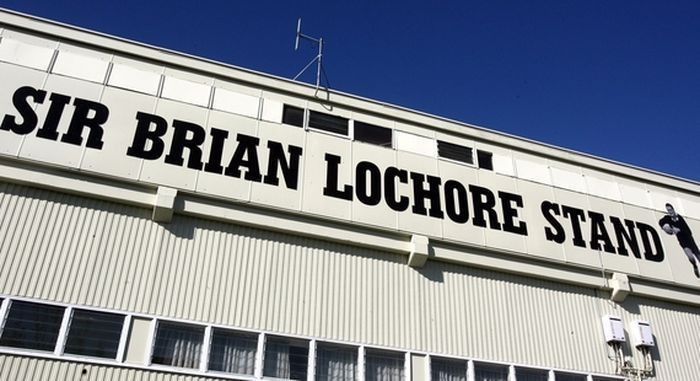
Above: The stand at Masterton's Memorial Park has been re-named in Sir Brian Lochore's honour. Image courtesy of the Wairarapa Bush Rugby Union.?
Entice Cafe in sleepy Masterton, an hour North of Wellington, is not a busy place on a Tuesday morning.
Sir Brian Lochore parks his ute in a parallel park outside.
An officious parking warden is loitering nearby. He is investigating BJ's vehicle thoroughly. It's oversized and the warden is poised to dish-out a ticket.
Relaxed and engaged, Lochore suddenly leaps from his chair and exits the cafe. He approaches the warden and looks at him sternly in the eye. Without saying a word, the warden vanishes.
Lochore calmly moves his ute, re-enters the cafe, and our interview resumes.
Lochore: All Black Captain, World Cup winning coach, long-time farmer, chairman of the Hillary Sports Commission, Commissioner of a local high-school that was heading to the dogs; BJ knows how to handle a crisis.
So what is the key to great leadership?
"Understanding people", Lochore says.
"Figuring out what makes them tick. Who needs to be yelled at and who needs to be treated gently?"
"In a rugby sense I always enjoyed the tactical challenge of captaincy, but I wasn't so keen on revving the boys up. I liked to have a group of senior players to confide in and with that I had lots of good decision-makers around me and my confidence grew."
Lochore humbly confesses he is a "shy country boy."
He grew up wanting to be a jockey and was an accomplished tennis player winning the Wairarapa Junior Championships four times.
However, rugby seemed preordained.
He was picked for the Wairarapa Primary Schools' rep team. Lochore laughs, "I didn't even touch the ball."
He made the Wairarapa College First XV in 1956, under the coaching of 1949 All Black reserve, Gordon Henderson.
In 1959 he played his first season of representative rugby for Wairarapa-Bush, with an appearance as a flanker, against the touring British Lions – a real highlight.
Lochore meet a great mentor that season, local icon and All Black "Kiwi" Blake - the only non-Maori to captain the New Zealand Maori.
"Kiwi was a wonderful man, very gentle and caring", Lochore recalls.
"I locked the scrum with him when he was 37 and I was 18. He was a great teacher. He was the first player to play hundred games for Wairarapa. In 1950 he led Wairarapa to a Ranfurly Shield win against Canterbury. Fullback Alf Mahupuka kicked the winning drop goal. His boot was put on display in Wairarapa shop windows such was the popularity of the win."
Lochore proved extremely popular with one spectator in the final All Black trial in 1963 at Athletic Park, Wellington. Lochore explains a rabid fan drove the players to distraction:
"There was this bloke on the hill who had a huge voice. He was shouting, 'Come on Lochore!' 'Come on Lochore!' The ground was full, but all you could hear was this bloke cheering me on. It was very embarrassing. I hope he wasn't the reason I got selected. The players were laughing at me."
Lochore wasn't an instant hit on the 1963/64 tour of the UK. He played in the shock defeat to Newport, the third fixture and only loss in 36 games.
Lochore failed to make the cut for the Irish and Welsh tests. He played six midweek games in two months. He and failed first-five Earle Kirton started calling each other 'Wednesday' (something they still do to this day).
Lochore's luck changed late on the tour. Waka Nathan was ruled out injured and Lochore was in the right place at the right time to earn news of his test debut against England in January, 1964.
"I was heading out of the hotel to play a game of squash when I was intercepted by manager Frank Kilby. He told me to stay put. Then he asked if I was fit to play England on Saturday. I said, ‘of course’. I wonder what would have happened if he hadn't caught me."
Despite "no preparation," Lochore was a success in his test debut; the All Blacks won 14-0, but Lochore enjoyed little of the tour.
"I learned more about captaincy when I wasn't captain. There was a divide between the younger players and the senior players on that tour. The test team didn't train with the midweek team. I remember being too frightened to knock on the hotel door of captain Wilson Whineray. When I was All Black captain I tried to be more inclusive of everybody."
The All Blacks showed little fear of the 1965 Springboks. They won the series 3-1 and only conceded tries in the third test, "shocker." South Africa rallied from 16-5 behind at halftime. Lochore laughs, "It wasn't my fault, I played concussed."
Kel Termain was in imperious form, scoring tries in each of the first three tests. In the scrums Ken Gray destroyed Sakkie van Zyl. Lochore elaborates:
"Sakkie was a real character. We all liked him. He made us laugh with his sharp sense of humour. During the third test in Christchurch the scrums kept collapsing. The pressure that Ken Gray was applying on Sakkie was forcing him to flop. He blamed the slippery surface. He warned, 'wait until I get a hard track.' It was fine at Eden Park for the fourth test. The first scrum packed down and it collapsed. We all heard this groan, 'Argh!.' It was Sakkie. Ken pulled him back to his feet and proceeded to work him over for the enter match."
In 1966, ahead of more experienced All Blacks and provincial captains, Colin Meads, Kel Tremain and Ken Gray, Lochore was appointed skipper for the British Lions series.
Fielding the same forward pack in each of the four tests the All Blacks whitewashed the tourists. Lochore scored a try in his first test as captain, but admits the Lions weren't a formidable side.
"They weren't the greatest Lions side to visit these shores. They seemed to be very divided with all the class barriers between the four countries prevalent at that time. I often say, the higher the class, the lower the morals."
Lochore greatly respected his opposite captain Mike Campbell-Lamerton. Born in Malta, the sherry-drinking Scot was a fellow flanker and a career soldier who endured plenty of hardship.
At one stage the Lions manager, Des O'Brien, had left the party, for a break in Fiji, and the coach, John Robins, was in hospital with damaged ankle ligaments, leaving Campbell-Lamerton in charge of the whole tour!
Prior to the tour Campbell-Lamerton avoided death three times. Aged 15, he was struck in the chest by a javelin.??He courted death again on foot patrol in Korea, when?he trod on a mine.? Hearing the faint click, he remained still while the corporal with him, who fortunately had worked in bomb disposal during the Second World War, rendered the mine safe. Three years later, serving in Cyprus, he fell 60ft from a helicopter in full combat gear, sustaining severe back, hip and leg injuries.?
Avoiding the media was something that Lochore wished had happened on the 1967 UK tour. The advent of colour television meant that Lochore spent a lot of time in television studios, while the rest of the team was socialising.
The All Blacks went undefeated in 17 games. Lochore identifies the 21-15 victory over France at the Colombes Stadium, Paris as the best of his playing career:
"I remember coming off the field and feeling totally exhausted. We moved the ball frantically that day to avoid the bigger French pack and everything worked; we outscored them four tries to one. The dressing room was like a funeral afterwards. The relief of pulling off a game like that was hard to describe. The non-test players couldn't understand our silence."
The All Blacks were nearly battered into silence by the 68 French. In the second of three tests in Wellington, Chris Laidlaw, Bruce McLeod and Colin Meads were all booted in the head as the French adopted a "kick everything, just in case it's the ball" attitude.
Lochore protested vigorously to referee John Pring:
"It got to the point where some of the players told me they couldn't take it anymore. It was ridiculous so I approached Pring and insisted something be done. Pring interpreted my protest as a criticism of his ability to control the game and it didn't get any better. The after-match function was very short."
Lochore insists the game wasn't dirty in his era.
"There were very few dirty players. You respected guys who were hard, but played with integrity. The thugs didn't last long because they were beaten out of the game. You didn't have television in those days so the feral acts often went unsighted by the referee. The players would sort out those who strayed."
Lochore won't criticise Walter Spanghero. He rates the French lock and No.8, who they called the 'Iron Man' and who President Georges Pompidou demanded become the national captain in 1969, the best player he marked in international rugby.
The 1970 Springboks proved to be fierce opponents during the All Blacks’ tour of that country. Lochore hadn't lost in 14 tests as captain prior to the South African tour, but the Springboks claimed the four test series, 3-1.
Missed opportunities, questionable refereeing and errors in selection irk Lochore to this day.
"I think we underestimated the Springboks. We wanted to move the ball quickly which was a fair call, but we were too ambitious and made simple mistakes," Lochore says.
Liberal advantage laws were applied in the midweek games. The All Blacks flourished by scoring a record 135 tries in 24 games. In the test matches the referees were most disruptive.
"We struggled to field the right combination to combat the Springboks forward pack. The games were very stop-start and that suited their style."
The All Blacks used 27 of their 30 players in the test series. Springbok fullback Ian McCallum, now a wildlife photographer, poet and doctor, dominated by kicking a record 35 points.
Perhaps the biggest reason for the failure in South Africa was the absence of Fred Allen. Lochore says Ivan Vodanovich was a "nice man," but not in the same class as a coach. Lochore explains why Allen resigned in 1968 with a perfect record.
"Alex Veysey was invited into an official team-talk before the first test against Australia in Sydney that year. He wrote a story about it in the Dominion the next day. Chairman of the NZFU, Tom Morrison strongly objected to Veysey's presence and reprimanded Allen. The team meetings were apparently sacrosanct. Tired of being questioned by the Union for that and other matters, Fred retired after the tour."
"I believe Fred would have made a big difference in South Africa as many of the players had come through with the 'Needle' and really respected him."
Respect was something that Lochore instantly attained as a coach. He mentored his home province Wairarapa Bush between 1980 and 1982 and took them into the First Division of the National provincial championship for the only time in their history.
Wairarapa Bush won 23 out of 38 games under Lochore and beat Otago, Waikato, Bay of Plenty, Southland and Hawke's Bay, unheard of today.
Lochore's expertise was eventually sought by the All Blacks. The first test he coached was the “Baby Blacks” test against Five Nations champions, France in 1986. Lochore describes the challenges:
" Thirty-three All Blacks were banned from playing the test because they went on the Cavaliers?tour to South Africa the previous year. We had to pick from what was left and we had ten debutants. In those days you couldn't assemble until three days prior to a test. The first training session was on a Wednesday and it was a disaster. We had to put name tags on the players. By Friday, I thought this team is okay."
The All Blacks won 18-9 in Christchurch, three drops goals were the difference. The All Blacks have never kicked more than three drop goals in a test!
Four starters ,captain, David Kirk, Sean Fitzpatrick, Joe Stanley and John Kirwin all played the World Cup final the following year.
Winning the World Cup was Lochore's greatest triumph as a coach. The All Blacks won all six games by twenty-plus points and scored 43 tries. Lochore showed his shrewdness as a man-manager.
Fifty players were selected to train months beforehand, something that had never happened before. This guaranteed the All Blacks were the fittest team at the tournament.
Lochore utilised the expertise of selectors Alex Wyllie and John Hart carefully. The pair had an infamously frosty relationship.
"I thought Alex and John had a lot to offer, but three coaches at the same time was too much, typically there was only one. What I decided to do was use Alex for matches in the South Island and John for matches in the North Island."
Originally appointed captain Andy Dalton, who was injured out of the tournament, travelled with the team to every game. He even gave speeches in the dressing room at halftime as Kirk wasn't so keen on that. Dalton could have played the final, but remained on the sideline not to disrupt the continuity of the team.
After the failure of the 1991 World Cup, Lochore was appointed campaign manager in 1995. The All Blacks stormed into the final, but succumbed to the Springboks after a serious bout of food poising. Lochore says the All Blacks produced one of their proudest performances that day.
"Those players did a remarkable job, no one will know what they went through. They were so sick. To play like they did was amazing," Lochore says.
Was the possibility of illness foreseen?
"Yes, we tried to get the Aussie chef to prepare our meals that week. He was respected and had nothing to do because the Wallabies were out of the tournament. The hotel management stopped it," Lochore says.
"Every day we had meals at roughly the same times as the guests. We figured there was less of a chance of something untoward happening if we ate with everybody else. On Thursday we were escorted into a separate room, which was unusual. We had beef and chicken burgers with tea and coffee. The following morning most of us were sick."
Was it a stitch-up?
"I can't say for sure. I don't believe the ‘Suzie’ theory that Laurie Mains has presented, but it was a disappointing way to end."
Lochore couldn't save the All Blacks from food-poisoning, but he did play an influential role in keeping many All Blacks aligned to the NZRFU after the tournament in the wake of the World Rugby Corporation threat.
Lochore is a man who puts his country first. His last test as a player was against the 1971 British Lions.
Retired and peacefully farming in Masterton the phone suddenly rung two days before the third test at Athletic Park. It was coach Ivan Vodanovich. He desperately needed a lock. After the phone call Lochore left a note on the kitchen table for his wife:
"Dear Pam, gone to play the test in Wellington."
Did You Know?
- Cliff Porter (v France, 1925), Wilson Whineary (2 v Australia, 1958), Jock Hobbs (v Argentina, 1985), Buck Shelford (v Wales, 1988), Justin Marshall (v Ireland, 1997) Taine Randall (2 v England, 1998), Todd Blackadder (v Tonga, 2000) and Kieran Read (v Italy, 2012) are the other All Blacks to score a try in their first tests as captain.
- Keith Murdoch played the fourth test against the Springboks in 1970 with appendicitis. Lochore descried Murdoch as the "perfect tourist."
- "Keith headed the social committee. He was a bit different for sure, but he loved the All Blacks. He wasn't the wild man he was portrayed as later, after being sent home from Britain in 1972."
- Claude Dourthe, who played centre for France against the All Blacks in 1968, was a dentist. Given the violence of the series there was a joke in the All Blacks at the time. “Don't go near Claude otherwise you’ll lose your teeth.” Claude is still the youngest French international. He debuted against Romania in 1966, aged 18 years and 7 days. His son Richard was also a centre who debuted against Romania in 1995. He scored a try in the 1999 World Cup semi-final against the All Blacks at Twickenham.

Steven White, 05 Feb 2017
Steven White, 17 Oct 2015
Beavan Dewar, 26 Jul 2015
Adam Julian, 13 Apr 2015
Steven White, 14 Aug 2011


.jpg "Rugby Heartland New Zealand")